
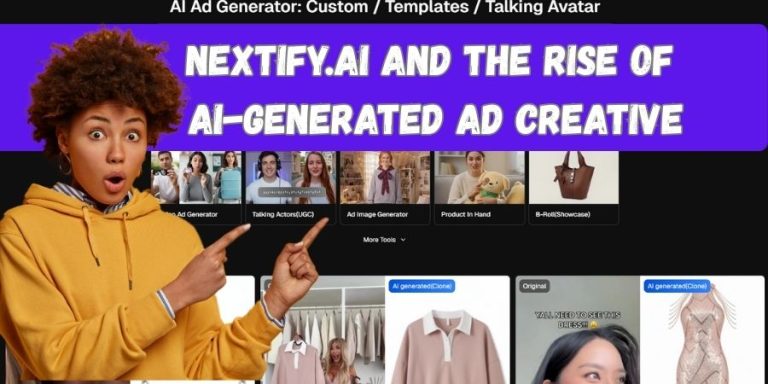
The last decade of digital advertising has been defined by one uncomfortable truth: targeting is no longer the hard part—creative is. Platforms can deliver reach and optimize bids, but your performance still rises or falls on whether your ad stops the scroll in the first second, communicates a clear promise, and earns a click (or a purchase) before the viewer moves on.
That pressure has created a new reality for marketers, agencies, and e-commerce operators:
- You need more creatives than ever.
- You need them faster than ever.
- And you need them optimized for each platform, format, and audience segment.
Traditional production can’t keep up. Hiring creators, shipping samples, booking shoots, editing variations, and coordinating approvals creates delays and costs that make rapid iteration nearly impossible. That’s exactly where platforms like Nextify.ai fit: a one-stop AI advertising studio designed to move you from idea to ready-to-launch ad creative—especially short-form video—without the traditional production bottlenecks.
This article unpacks what Nextify.ai is, how it works, what kinds of ads it helps you create, and how to use AI-generated creative responsibly while improving performance metrics like CTR, CPA, and ROAS.
Why Ad Creative Became the Bottleneck (and Why It Matters)
Digital advertising used to reward clever targeting and budget discipline. But as privacy changes, attribution limits, and platform shifts made targeting less deterministic, creative has become the most controllable lever left.
At the same time, the creative bar keeps rising. Users are trained by TikTok, Reels, and Shorts to expect fast, native-feeling content that looks like something a real person made—not a polished commercial. Even for paid ads, the “UGC style” (user-generated content) has become the dominant format because it feels authentic and blends into the feed.
The downside is obvious: UGC is labor-intensive. Getting enough creators, managing contracts, waiting for footage, and editing multiple hooks can drain time and money. Many teams respond by running fewer creatives longer—which leads to creative fatigue, higher CPAs, and declining ROAS.
The highest-performing advertisers do the opposite: they test more angles, more hooks, more intros, more voiceovers, more scenes, and more variations. Their advantage is iteration speed. AI ad creation tools are designed to compress that iteration loop from weeks to hours—or even minutes.
Was Nextify.ai Is (in Plain English)
Nextify.ai positions itself as an AI ad generator and AI ad creative platform built to create high-performing ad creatives from a single place. The core promise is straightforward: you supply a product image, a concept, a script, or a product URL/description, and Nextify helps generate the building blocks of a ready-to-launch ad—scripts, visuals, voiceovers, scenes, and variations—formatted for major social platforms.
Instead of thinking of it as “one tool,” think of Nextify as a suite of AI creative workflows for advertisers:
- AI video ad generation from product images and prompts
- AI UGC-style ads using talking avatars (AI actors) with lip-sync and gestures
- “Product in hand” style demos generated from a product image
- B-roll / showcase sequences with multi-angle product shots
- Unboxing POV and app showcase templates
- AI commerce photography and image editing tools for product visuals
- Batch creation for A/B testing multiple variations quickly
- Options for custom avatar and voice cloning (where supported)
For many teams, the practical impact is less about replacing all production and more about multiplying output. You can still film “hero” content when needed—but use AI to generate the volume of variations and testing creatives that keep performance stable.
The Core Output: Feed-Native Short-Form Ads
If you’ve run paid social, you already know the “spec sheet problem.” A single campaign often needs:
- 9:16 vertical for TikTok/Reels/Shorts
- 1:1 square for some placements
- 16:9 for YouTube or certain placements
- Multiple versions to avoid fatigue
- Different language variants for new markets
- Different voiceovers or captions for Zugänglichkeit
Nextify is designed around this multi-output reality. Its flows emphasize rapid creation and format-ready exports so you can push creatives into testing without constant resizing, re-editing, and re-rendering.
Key Creative Modes You’ll See Inside Nextify.ai
1) AI UGC Ads with Talking Actors
UGC works because it feels like a recommendation from a real person. Nextify’s “Talking Actors” approach aims to replicate that feel by using AI avatars that deliver your script with lip-sync and natural movement. The platform highlights large avatar libraries, multi-language support, scene switching, and gesture options.
Where this shines:
- Script-driven “review” ads (“I tried this for 7 days…”)
- Problem/solution formats (“If you struggle with X…”)
- Founder-style explainers without filming a founder
- Localization: the same script concept adapted across languages
What to watch for:
- Keep scripts conversational. If it sounds like a brochure, it will feel artificial.
- Use short sentences, natural pauses, and occasional imperfections to maintain “native” tone.
- Make sure claims are compliant and verifiable for your category.
2) “Product In Hand” Demos
A major challenge in e-commerce ads is demonstrating a product without filming it. Nextify’s “Product in hand” concept is built around generating realistic hand-held demos from a product image—like someone holding, turning, pointing to, or showing the product in use.
Where this shines:
- Dropshipping or fast testing when you don’t have physical inventory
- New product launches where you need “first creatives” quickly
- Variations: same product, different contexts, angles, or lighting styles
What to watch for:
- Use high-quality product images with clear edges and good lighting.
- Avoid products that require precise mechanical demonstration unless the generation is consistently accurate.
- Consider adding on-screen text to clarify features that might not be visually obvious.
3) B-Roll / Product Showcase Ads
B-roll is the backbone of many winning ads: close-ups, detail shots, slow pans, quick cuts, lifestyle context. Nextify’s b-roll generation focuses on multi-angle shots, 360-style views, close-ups, and cinematic movements based on your product imagery and prompts.
Where this shines:
- Skincare, beauty, gadgets, accessories—anything visual
- Retargeting ads that emphasize features and detail
- “Premium” positioning where lighting and texture matter
What to watch for:
- Keep the message simple. B-roll should support a single claim per segment.
- Use captions and overlays to direct attention (benefit, proof, CTA).
4) Unboxing POV and App Showcase Templates
Unboxing is a proven UGC format because it’s instantly understandable: anticipation, reveal, first impressions. App showcases work similarly for mobile products: show the UI, demonstrate the main action, end with a CTA.
Where this shines:
- Subscription boxes, gadgets, cosmetics, small consumer goods
- Apps with a clear before/after or quick demo
- “How it works” creatives for cold traffic
What to watch for:
- Your hook matters more than your template. The first second still wins or loses.
- For app ads, don’t show too many screens. One job per ad.
5) AI Commerce Photography and Ad Image Tools
Not every placement needs video. Catalog ads, retargeting, and static placements still work—if the creative is strong. Nextify includes an AI commerce photography approach that emphasizes lighting, shadows, reflections, background replacement, and editing tools (like background removal, inpaint/erase/expand, and upscaling).
Where this shines:
- Turning generic supplier images into premium visuals
- Creating “lifestyle” imagery without a shoot
- Rapid A/B testing: different scenes, colors, angles, and compositions
What to watch for:
- Ensure your visuals match your actual product accurately to reduce returns and complaints.
- Maintain brand consistency: repeated colors, typography, and layout rules.
Wie Nextify’s Workflow Typically Works
Most AI creative platforms succeed or fail based on workflow—how quickly they get you to a usable asset, not how impressive the demo looks.
Nextify presents a simple end-to-end approach:
- Input your idea (product URL, product description, concept, script, or images)
- Pick a style (templates, scenes, avatars, aspect ratios, creative directions)
- Let AI build the ad (script, visuals, voiceover, effects)
- Export and scale (HD exports and batch variations for testing)
The takeaway: the platform is optimized for iteration. You’re not expected to “get it perfect” in one generation. You generate, pick, tweak, and batch.
The Real Advantage: Creative Volume Without Creative Chaos
The biggest hidden cost of producing more ads is coordination. More output can mean more disorganization—files everywhere, inconsistent messaging, and endless rounds of edits.
An “all-in-one” ad studio can reduce that chaos by keeping creation modes, templates, and generation options in one place. That matters because most winning campaigns are not a single brilliant ad—they are a system of creatives:
- Multiple hooks for cold traffic
- Proof-based creatives for consideration
- Offer-focused creatives for retargeting
- Seasonal variations
- Localization versions
- Plattformspezifische Anpassungen
If you can generate and manage that system faster, you gain a durable performance edge.
Who Benefits Most From Nextify.ai
Based on how the platform positions its features and workflows, Nextify tends to fit best for:
E-commerce sellers and dropshippers
If you’re testing products rapidly, you often don’t have time (or inventory) for production. AI creatives let you validate demand before you invest in filming or buying stock.
Media buyers and performance marketers
Performance marketing is a testing game. When you can generate 10 variations instead of 2, you learn faster and find winners sooner.
Agenturen
Agencies face constant creative requests and client approvals. AI-generated first drafts can speed up ideation, give clients more options, and reduce dependence on external creator pipelines.
Kleine Unternehmen
Smaller brands usually have limited production budgets. AI tools can help them compete visually and maintain a steady flow of fresh creatives without hiring a full-time editing team.
Understanding Credits and Pricing (and How to Think About Cost)
Nextify uses a credit-based subscription model, including a free tier and multiple paid plans. What matters is not only the monthly price, but what it replaces:
- Creator fees
- Editing hours
- Studio costs
- Time delay (which is often more expensive than cash)
If AI-generated ads help you find a winning hook faster, the ROI can be large even at modest scale. The smartest way to evaluate pricing is to run a controlled experiment:
- Generate a batch of AI creatives for one product
- Test them against your current best creatives
- Compare results across CTR, CPC, CPA, and ROAS
- Measure how many “usable” creatives you get per credit
That converts “price” into “cost per testable asset,” which is the metric that matters for performance teams.
How to Get Better Results: A Practical Playbook
AI tools don’t eliminate creative strategy. They make it easier to execute strategy at scale. The teams that win with AI follow a repeatable process.
Step 1: Start With a Clear Creative Angle
Before you generate anything, decide the angle:
- Problem/solution (“If you struggle with…”)
- Transformation (“Before vs after”)
- Social proof (“Everyone’s switching to…”)
- Objection handling (“I thought it wouldn’t…”)
- Offer-based (“Limited time bundle…”)
- Demo-first (“Watch this in action…”)
Pick one angle per ad. AI generation becomes dramatically better when your intent is focused.
Step 2: Write a Hook That Can Survive Without Context
Most viewers will decide in one second whether to keep watching. Hooks that consistently work are:
- A sharp promise (“Here’s how to cut X in half…”)
- A surprising fact (“Most people do this wrong…”)
- A bold opinion (“Stop buying…”)
- A relatable pain (“If your skin feels…”)
- A fast demo (“Watch what happens when…”)
Keep it short. One sentence. No warm-up.
Step 3: Use a Simple Script Structure
A dependable short-form structure is:
Hook (0–2s)
Problem (2–5s)
Solution (5–12s)
Proof / specifics (12–20s)
Offer / CTA (last 3–5s)
You can generate multiple versions by changing only the hook, or only the proof, or only the offer—without rewriting the entire script.
Step 4: Generate Variations in Batches
If the platform supports batch creation, use it intentionally. A useful batch might be:
- 5 different hooks, same body
- 3 different avatars, same script
- 3 different scenes/contexts, same product
- 2 voiceover tones (calm vs energetic)
- One version with captions heavy, one lighter
That’s already 30 combinations from a small set of variables. You don’t need 30 at once, but you do need systematic experimentation.
Step 5: Test, Then Rebuild Winners Into “Families”
When you find a winner, don’t just scale it—clone its underlying pattern:
- Same hook style, new product feature
- Same structure, new avatar
- Same offer, new proof
- Same visuals, new headline overlays
Winning ads often become “templates” for future winners.
Creative Authenticity: How to Avoid the “AI Feel”
The fastest way to waste credits is to produce ads that look impressive but feel inauthentic. Feed-native advertising has its own language.
To keep AI creatives feeling native:
- Use casual, spoken language
- Add specifics (days, use case, routine, situation)
- Avoid corporate adjectives (“revolutionary,” “cutting-edge”) unless your brand truly speaks that way
- Keep pacing brisk; cut filler phrases
- Use captions that match how people talk, not how brands write
- Add proof elements: ratings, short testimonials, results, clear product shots
The goal is not to fool anyone. The goal is to communicate like the platform’s culture—fast, clear, human.
Commercial Rights, Uniqueness, and Responsible Use
AI-generated ads raise practical questions that every advertiser should think about:
Are outputs unique?
Generative systems can produce similar results for different users, especially if prompts are similar. Practically, that means you should still develop brand-specific creative direction—your voice, your offer, your visual identity—so your ads don’t blend into a sea of lookalikes.
Can you use outputs commercially?
Nextify presents commercial rights as part of the value proposition. Even with commercial rights, advertisers should operate with common sense:
- Don’t imply endorsements you don’t have
- Don’t make medical/financial claims you can’t substantiate
- Don’t create misleading visuals that contradict the real product
What about brand trust?
Long-term brands win by aligning the creative promise with the product experience. AI makes it easier to scale creative—so it also makes it easier to scale mistakes. Use AI to amplify what’s true and useful about your product, not to exaggerate.
Where AI Ad Creation Is Headed Next
Tools wie Nextify sit at the intersection of three accelerating trends:
- Short-form video dominates performance advertising
- Creative testing volume is becoming the core advantage
- Generative AI is moving from “novelty” to “workflow infrastructure”
In the near future, the competitive baseline won’t be “Can you make video ads?” It will be “Can you generate, test, learn, and iterate faster than competitors?”
AI ad studios push the industry toward that future. The teams that adapt early tend to build a compounding edge: better data on what works, stronger creative systems, and faster cycles.
Final Thoughts: How to Decide If Nextify.ai Fits Your Stack
Nextify.ai is best understood as a creative throughput engine—an all-in-one environment designed to generate ad-ready videos and images quickly, with UGC-style formats that match today’s winning patterns on TikTok, Reels, Shorts, and Meta placements.
If your biggest pain is any of the following:
- You’re constantly short on fresh creatives
- You can’t test enough hooks per week
- Creator sourcing and shipping slows you down
- Editing variations eats too much time
- You need multilingual or multi-format assets quickly
…then an AI ad generator workflow can meaningfully change your results.
The most realistic expectation isn’t “AI will replace my entire creative process.” It’s this: AI can produce the volume of testable ad variations you need to consistently find winners—while your team focuses on strategy, offers, positioning, and the handful of hero assets that define your brand.