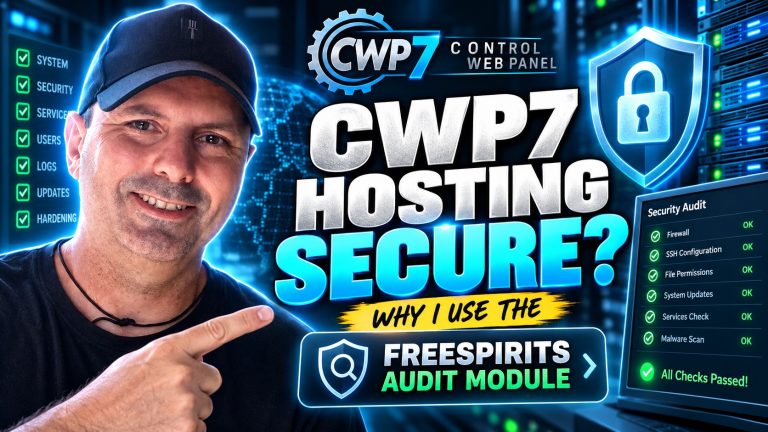
Is Your CWP7 Server Really Secure? Meet the Freespirits CWP7 Security Ecosystem
Managing a CWP7 server is about far more than keeping websites online.
A modern hosting server must remain secure, responsive, stable and protected against resource abuse while potentially serving dozens or even hundreds of websites, databases, email accounts and applications.
The problem is that most administrators are forced to manage these responsibilities through completely separate tools.
One application monitors security. Another handles the firewall. Another checks performance. Another monitors processes. Another scans files. Another reports CPU usage.
And somewhere in the middle of all that information, the administrator still has to answer three very important questions:
- Is something suspicious happening on my server?
- Is something attacking or exhausting my server resources?
- Is my server actually operating as efficiently as it should?
This is the philosophy behind the Freespirits CWP7 ecosystem.
Instead of trying to create one enormous application that attempts to do everything, Freespirits has developed three specialized CWP7 administration modules, each focused on one critical responsibility.
Freespirits Security Audit Module
Audit the server, detect suspicious conditions and investigate security findings.
CWP7 Resource Shield
Detect abusive traffic and help protect server resources from malicious or coordinated activity.
CWP7 Turbo Manager
Optimize the server environment for greater speed, efficiency and hosting performance.
Together they create a simple but powerful philosophy:
AUDIT → PROTECT → OPTIMIZE
And the first part of that ecosystem begins with visibility.
Freespirits Security Audit Module for CWP7 Pro
You cannot protect what you cannot see.
A CWP7 server can appear perfectly healthy from the outside while something dangerous is developing underneath the surface.
A suspicious cron job may have been added.
An unexpected executable may appear inside the filesystem.
An SSH authorization key may have changed.
A persistence mechanism could exist inside system configuration.
A suspicious communication pattern may require investigation.
Or a server that was correctly hardened months ago may no longer match the security baseline you expect today.
Finding these problems manually usually means connecting through SSH and checking numerous locations, configurations, logs and system services individually.
Les Freespirits Security Audit Module was created to bring these checks together into one structured CWP7 administration workflow.
Its purpose is not to replace the Linux administrator.
Its purpose is to make the administrator dramatically more effective.
From Endless SSH Commands to a Structured Security Audit
Experienced administrators know how powerful SSH is.
But they also know how much time a serious server investigation can consume.
You may need to inspect:
- system processes
- cron jobs
- SSH authorization
- systemd configuration
- recent executable files
- unexpected persistence mechanisms
- suspicious filenames
- security hardening settings
- system configuration changes
- potential Indicators of Compromise
- possible Command-and-Control activity
The Security Audit Module brings this investigation into a structured interface.
Instead of asking:
“What should I check first?”
you can begin by reviewing the audit results.
When deeper investigation is necessary, SSH becomes the second step instead of always being the first step.
You already know where the potential problem is.
A Security Dashboard Designed for Administrators
One of the biggest challenges with many security products is information overload.
A scanner may return hundreds of warnings without making it clear which ones actually deserve immediate attention.
The Freespirits Security Audit Module uses an understandable classification system:
PASS
The expected condition was found and the particular security check completed successfully.
INFO
Useful server information that the administrator should be aware of but which does not necessarily indicate a problem.
REVIEW
A condition deserves administrator attention or additional verification.
FAIL
A potentially important condition has been identified that requires investigation.
This structure allows an administrator to quickly move from an overall security overview into the areas that actually matter.
Instead of drowning the administrator in raw information, the system helps prioritize investigation.
Evidence Matters More Than Warnings
A good security tool should not simply display a red warning and leave the administrator wondering what happened.
Every warning should help answer:
- What was detected?
- Why was it detected?
- Where was it detected?
- What should the administrator investigate?
This is why the Security Audit Module places strong emphasis on evidence-based findings.
Where appropriate, administrators can move from the security finding toward the relevant evidence rather than simply receiving a generic warning.
This is particularly valuable when distinguishing between a genuine compromise indicator and an unusual but legitimate server configuration.
Read-Only Auditing: The Administrator Remains in Control
One of the core principles of the Security Audit Module is extremely important:
Detection should not automatically become destruction.
Imagine a security system incorrectly identifying a legitimate production process as malicious and automatically deleting it.
Imagine it modifying a configuration file and taking customer websites offline.
Imagine an automated security action removing something that turns out to be critical infrastructure.
On a production hosting server, aggressive automated remediation can sometimes create as many problems as it solves.
The Freespirits Security Audit Module therefore follows a primarily read-only auditing philosophy.
SCAN → DETECT → PRESENT EVIDENCE → ADMINISTRATOR DECIDES
The administrator stays in control of the server.
The module helps provide the information needed to make that decision intelligently.
Checking for Suspicious Persistence
Not every attack is designed to immediately destroy a server.
Some attacks are designed to survive.
An attacker who gains temporary access may attempt to create a mechanism that allows access to return later.
This is why persistence detection is such an important part of server auditing.
The Freespirits Security Audit Module examines important areas associated with persistence and system modification, including checks around technologies and locations such as:
- cron
- systemd
- SSH authorization
- ld.so.preload
- recent executables
- suspicious system files
- known Indicator-of-Compromise patterns
These are exactly the types of areas that an experienced administrator might inspect manually during an investigation.
The difference is that the module provides a repeatable auditing process.
SSH Authorization Checks
SSH is one of the most powerful interfaces on a Linux server.
For the same reason, unexpected SSH authorization changes deserve immediate attention.
The Security Audit Module helps expose relevant SSH authorization conditions so the administrator can verify that access remains consistent with the expected configuration.
For hosting administrators managing several servers, having this visibility available from within the CWP7 workflow can significantly reduce investigation time.
Cron and Scheduled Task Analysis
Cron is essential to Linux hosting.
Backup systems use it.
Maintenance scripts use it.
Applications use it.
Unfortunately, attackers can use it too.
A malicious scheduled task may repeatedly execute a command, restore unwanted files, reconnect to another system or recreate something the administrator previously removed.
Identifying unusual cron activity is therefore an important part of any serious compromise investigation.
The Freespirits Security Audit Module includes checks designed to help expose cron anomalies and suspicious scheduled activity for administrator review.
Indicators of Compromise and Suspicious Files
Compromised systems often leave traces.
These traces may include suspicious filenames, unexpected executable files, unusual filesystem locations or modifications associated with known attack techniques.
The Security Audit Module can inspect server conditions for these types of indicators and bring relevant findings into the audit report.
Again, detection does not automatically mean that every file is malicious.
Context matters.
That is why the module’s evidence-driven approach is so important.
Command-and-Control Indicators
When malware successfully enters a system, the compromised machine may attempt to communicate with external infrastructure controlled by an attacker.
This is commonly associated with Command-and-Control, often abbreviated as C2.
Potential C2 indicators are important because a server may appear operational while unwanted software communicates externally in the background.
The Security Audit Module incorporates checks intended to help surface suspicious conditions that could justify deeper investigation.
Kernel-Level and Process-Oriented Security Checks
Some threats attempt to hide behind normal-looking processes or imitate kernel-related activity.
These cases can be significantly more difficult to identify through casual observation.
The Freespirits auditing workflow includes checks designed to identify suspicious process or kernel-thread-related conditions that deserve administrator attention.
This is another example of why structured server auditing matters.
The administrator does not need to remember every individual forensic command before beginning an investigation.
Security Is Not Only About Malware
A server can be completely free from malware and still have poor security.
Security also includes hardening.
It includes ensuring that dangerous access paths are restricted.
It includes verifying that expected protections remain active.
It includes ensuring that previous security actions have actually remained in place.
The Security Audit Module therefore also examines server hardening conditions and operational baselines.
This allows the administrator to distinguish between two different questions:
Has something suspicious happened?
and:
Is this server configured the way I expect it to be?
Both questions matter.
The Bigger Problem: Security Auditing Alone Is Not Enough
This is where the wider Freespirits ecosystem becomes important.
Auditing helps you understand the server.
But administrators face another major threat every day:
resource exhaustion.
A website may receive automated attacks, aggressive bots, repeated requests, brute-force traffic or coordinated activity that consumes:
- PHP-FPM workers
- CPU
- RAM
- database capacity
- network resources
The server may technically still be online while legitimate customers experience slow websites and failed requests.
This is where the second part of the Freespirits ecosystem comes into play.
CWP7 Resource Shield: PROTECT
CWP7 Resource Shield focuses on identifying malicious or abusive activity that threatens the availability of the hosting environment.
Its purpose is different from Security Audit.
The Audit Module asks:
“What is happening inside my server?”
Resource Shield asks:
“Who is consuming or attacking my server resources?”
Resource Shield is designed around server-wide protection rather than looking at individual websites in isolation.
In environments using Cloudflare, it can help administrators detect malicious sources and coordinate protective blocking across the Cloudflare infrastructure associated with the server.
Optional CSF integration can provide another layer of defensive capability.
The system is also designed with administrator protection in mind so trusted management access is not accidentally treated like hostile traffic.
For administrators operating multiple servers, the ecosystem can even support more advanced server architectures and coordinated environments.
The objective is simple:
Stop abusive traffic before it continues wasting valuable hosting resources.
CWP7 Turbo Manager: OPTIMIZE
Once the server can be audited and protected, the third question becomes:
How efficiently is it running?
This is the role of CWP7 Turbo Manager.
Security and performance are closely connected.
A server may be secure but poorly configured.
Resources may exist but not be used efficiently.
Websites may work but respond more slowly than they should.
PHP workers, caching and other hosting components can all influence how much performance customers actually receive from the same physical or virtual server.
Turbo Manager focuses on the optimization side of the Freespirits ecosystem.
Its objective is to help administrators get more performance, responsiveness and efficiency from their CWP7 infrastructure.
Three Modules. Three Responsibilities. One Ecosystem.
The logic behind the Freespirits architecture can therefore be summarized very clearly:
1. AUDIT
Freespirits Security Audit Module
Understand the security condition of the server, identify suspicious activity and investigate findings.
2. PROTECT
CWP7 Resource Shield
Identify abusive traffic and protect server resources against malicious or coordinated consumption.
3. OPTIMIZE
CWP7 Turbo Manager
Improve server efficiency, hosting performance and the delivery of websites hosted on the system.
These products are not intended to replace CWP7.
They extend it.
They add an administrator-focused layer around the hosting platform that concentrates on problems that become increasingly important as a server grows.
Why This Matters Even More for Hosting Providers
If you host one personal website, a server problem is inconvenient.
If you host 50 customer websites, it becomes a business problem.
If you operate hundreds of websites, one server-level incident can become a serious operational crisis.
A hosting server can contain:
- business websites
- e-commerce stores
- customer databases
- email accounts
- CRM systems
- WordPress installations
- custom applications
- customer files
Protecting the server therefore means protecting everything depending on it.
The value of better visibility, faster investigation and earlier detection increases dramatically as the number of customers grows.
The Goal Is Not to Replace the Administrator
Automation should make skilled administrators more powerful, not remove them from the decision-making process.
This philosophy runs throughout the Freespirits CWP7 ecosystem.
Security Audit provides evidence.
Resource Shield helps enforce protection.
Turbo Manager helps improve efficiency.
But the administrator remains responsible for the server and remains in control.
That is particularly important in professional hosting environments where blindly applying automated fixes can be dangerous.
Built From Real CWP7 Administration
The Freespirits modules were created around real hosting administration challenges rather than theoretical dashboards.
The questions behind development are practical ones:
- How can I identify a suspicious server condition faster?
- How can I find evidence without searching manually for hours?
- How can I identify abusive traffic affecting several websites?
- How can I protect resources before PHP-FPM, CPU or RAM become exhausted?
- How can I make the server faster without repeatedly performing the same manual optimization tasks?
- How can all of this become easier to manage through CWP7?
Those questions led to the three-module ecosystem.
Why the Security Audit Module Is a Must-Have for Serious CWP7 Administrators
No security product can honestly promise that a server will never be compromised.
That is not how cybersecurity works.
The goal is to create layers.
Prevent what can be prevented.
Detect what gets through.
Identify unusual behavior quickly.
Provide enough evidence to investigate intelligently.
Reduce the time between an incident beginning and an administrator understanding what is happening.
That is where the Security Audit Module becomes extremely valuable.
It provides a security perspective directly relevant to the environment a CWP7 administrator actually operates.
And perhaps most importantly, it turns security auditing from an occasional manual exercise into a repeatable administrative process.
The Platform Will Continue to Evolve
Cybersecurity does not remain static.
Attack techniques evolve.
Linux evolves.
CWP7 evolves.
Hosting environments evolve.
The Freespirits ecosystem is therefore being developed as a living set of administration tools.
As real-world security conditions are encountered, detection logic can improve.
New audit checks can be introduced.
Evidence presentation can become more useful.
Automation can become more sophisticated.
Protection mechanisms can expand.
Performance management can become increasingly intelligent.
This is precisely why the current pricing should not be considered permanent.
Get It Before the Price Increases
The Freespirits Security Audit Module is rapidly evolving into a significantly more sophisticated CWP7 administration and cybersecurity tool.
As additional security intelligence, auditing capabilities, automation, reporting and administrator functionality are introduced, the product will not remain at its current pricing level indefinitely.
This is a high-end server administration tool being developed around real-world hosting environments.
If you operate a CWP7 server, now is the opportunity to add the Security Audit Module to your infrastructure while the current pricing is still available.
The capabilities are growing. The ecosystem is growing. And the value of the platform is growing with them.
AUDIT. PROTECT. OPTIMIZE.
The modern CWP7 administrator should not have to choose between security, resource protection and performance.
All three matter.
This is the foundation of the Freespirits CWP7 ecosystem:
Freespirits Security Audit Module gives you visibility.
CWP7 Resource Shield gives you protection.
CWP7 Turbo Manager gives you optimization.
Together they create a growing administration layer designed specifically for professionals who want more control over their CWP7 l'infrastructure.
Because professional serveur management should not begin when something goes wrong.
It should continuously help you understand what is happening, protect the resources you depend on and extract the best possible performance from the infrastructure you already own.
Freespirits CWP7 Écosystème
AUDIT → PROTECT → OPTIMIZE
Three specialized modules. One administration philosophy.
Better visibility. Stronger protection. Faster servers.