AI Swipe Prompt Creator Pro Review: Does URL-Based Offer Analysis Make Marketing Prompt Creation Easier?
AI Swipe Prompt Creator Pro is designed to shorten one of the least exciting parts of marketing: researching an offer before asking an AI tool to write promotional content. Instead of manually reading a sales page, identifying its audience, extracting benefits and deciding on a marketing angle, the software is intended to start with an offer URL and produce three structured, AI-ready prompt directions.
I tested the product for this review. Since no specific test measurements or campaign results were supplied with my testing context, I am not going to claim conversion improvements, time savings or output quality beyond what the product documentation supports. My assessment focuses on the stated workflow, the features presented by the vendor, the practical strengths and the important setup and pricing questions a buyer should consider.
The central idea is useful. AI writing tools are only as helpful as the information they receive, and a vague request such as “write an email promoting this product” usually leaves too much strategic work to the model. Pro attempts to improve that starting point by organizing offer information first, then turning it into three different promotional approaches.
What AI Swipe Prompt Creator Pro Is
AI Swipe Prompt Creator Pro is an upgrade to AI Swipe Prompt Creator. The standard product is described as a tool for entering marketing information and generating three promotional prompt angles. The Pro version adds offer analysis intended to reduce the amount of information the user has to research and enter manually.
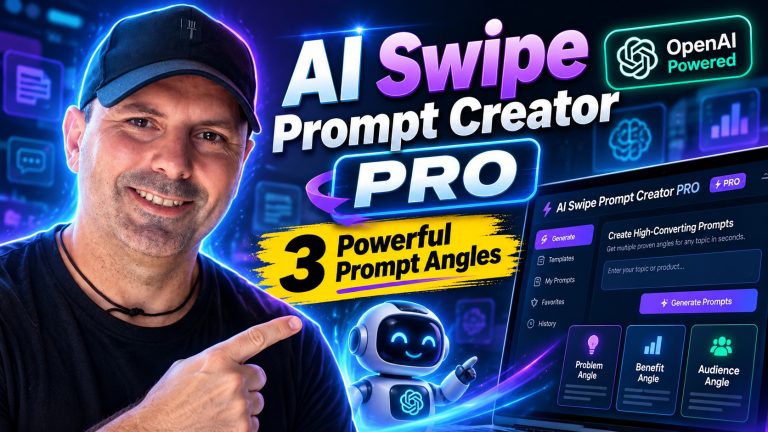
The advertised starting point is simple: paste the URL of an affiliate offer, software product, digital product, service, sales page or other promotion. The system is then intended to analyze available information and organize details such as the product’s purpose, target audience, pain points, benefits, features, positioning, objections and possible calls to action.
After that analysis, Pro creates three detailed prompts. These are not presented as finished emails, sales letters or advertisements. They are prompts that can be copied into ChatGPT or another compatible AI writing platform to create the final promotional material.
That distinction matters. Pro is primarily a research-and-prompt-preparation tool, not a complete copywriting platform. It does not eliminate the need to check claims, choose an audience, edit the resulting copy or decide whether the proposed angle is appropriate for a particular campaign.
How the Workflow Works
Step 1: Paste an offer URL
The intended workflow begins with a link rather than a blank form. The source says the URL may point to an affiliate offer, a software product, a service, a course, a membership, an e-commerce promotion or a client campaign.
This is the most distinctive convenience of the Pro upgrade. A marketer who works with several offers may otherwise need to open each sales page, take notes and manually convert those notes into useful AI instructions. Starting with a URL has the potential to make that preparation more consistent, particularly when the offer page already contains clear information about the audience and benefits.
Step 2: Let the system organize the available information
Pro is described as using OpenAI-powered analysis to interpret information available through the offer URL. It is intended to identify the product name and purpose, the likely audience, relevant frustrations, benefits, features, objections and positioning.
The wording “available information” is important. This is not the same as guaranteeing a complete understanding of every offer. Pages may be difficult to access, may contain limited copy or may restrict automated retrieval. The vendor acknowledges that some pages cannot be analyzed properly and says users can review, edit or manually supply information when necessary.
Step 3: Generate three promotional directions
The software organizes the output around three strategic approaches:
- Pain, relief and a simple next step: This approach starts with the audience’s frustration, presents the offer as a practical response and moves toward an uncomplicated action.
- Curiosity, hidden mechanism and discovery: This direction emphasizes the method, mechanism or different approach behind the offer and is positioned for products where curiosity can support the promotion.
- Doubt, reframe and easy win: This approach recognizes likely hesitation, reframes an objection and presents the offer as worth investigating.
These are useful starting structures rather than guaranteed winning formulas. A pain-focused angle may suit a problem-aware audience, while an objection-led angle may be more appropriate for a skeptical audience or a product that requires greater trust. The value is in getting three deliberate directions instead of asking an AI system for one generic piece of copy.
Standout Features
Automated audience and pain-point analysis
Pro is intended to help identify who an offer appears to serve and what problems it addresses. This can be useful when working with unfamiliar products, especially if the user understands marketing but does not yet know the product category well.
However, extracted audience descriptions and pain points should be treated as working hypotheses. An AI system may infer an audience from sales language, but that does not make the inference market research. I would still compare the proposed audience with the product owner’s information, existing customer data and the actual campaign goal.
Benefit, feature and positioning extraction
The tool is also designed to separate practical features from promotional benefits and organize the offer’s positioning. This is a worthwhile distinction. Features describe what a product includes, while benefits explain why those elements might matter to a buyer.
Better organization at this stage can help produce more focused prompts. It may also reduce the temptation to copy a long list of sales-page claims into an AI request without explaining which points matter most to the audience.
Objection and angle discovery
Objection analysis is another potentially valuable part of the workflow. Buyers may worry about complexity, price, trust, compatibility, time or whether a product is suitable for beginners. Asking an AI system to consider objections can lead to more balanced prompts than focusing only on positive features.
That does not mean every objection suggested by the software will be relevant. The user still needs to check whether an objection is genuine, whether it can be answered honestly and whether addressing it is suitable for the channel.
Copy-and-use prompt output
The resulting prompts are intended to be copied into a preferred AI writing platform. The source specifically mentions ChatGPT and other compatible assistants, while also emphasizing that the final writing environment remains flexible.
This platform-neutral approach is sensible for users who already have an AI writing workflow. Pro is not trying to force the entire process into one editor. Instead, it prepares context that can be taken elsewhere for email copy, promotional posts, advert concepts or other marketing content.
Project storage, tone and length controls
The feature list also mentions project storage, fast regeneration, tone controls and length controls. The stated tone directions include friendly, educational, story-based and direct-response styles. Length controls are described as supporting swipe detail and subject-line direction.
These features could make repeat work more manageable, although the source does not provide detailed technical specifications about storage limits, supported formats or the exact range of controls. Buyers who need advanced campaign management should therefore confirm those details before relying on Pro as a central production system.
Everyday Use and Practical Benefits
The strongest use case is repetitive offer preparation. If I were promoting several affiliate products or handling multiple client campaigns, the repeated sequence would normally involve reading each sales page, identifying the audience, extracting benefits, considering objections and deciding how to frame the promotion. Pro is built around reducing those repeated manual steps.
It may be particularly helpful when an offer is unfamiliar but has a reasonably informative sales page. Instead of beginning with an empty prompt, the user can start with a structured summary and three potential directions. That can make brainstorming more concrete and may help prevent generic AI output caused by insufficient context.
The three-angle approach is also practical for testing concepts before producing a large amount of content. A marketer can compare a problem-focused direction with a curiosity-based direction and an objection-reframing direction, then select the one that best matches the audience and traffic source.
There is a useful human-control element here. The vendor says users can review and edit the extracted information before generating prompts. That is essential. AI should assist with organizing an offer, not become the final authority on what a product does or what it can legitimately promise.
Limitations and Important Caveats
The first limitation is URL accessibility. Pro cannot reliably analyze information it cannot retrieve. Pages that block automated access, depend heavily on scripts or provide little useful text may produce incomplete results. The software’s manual editing option helps, but it means the workflow is not always as automatic as the headline concept suggests.
The second limitation is accuracy. Product descriptions, benefits, objections and audience profiles generated from a sales page may be plausible without being correct. Users should verify claims, remove unsupported promises and avoid publishing AI-generated material without review.
The third limitation is that prompt quality does not guarantee campaign performance. Conversions depend on the offer, audience, traffic, pricing, trust, execution and final content. Pro can help structure preparation, but it cannot validate demand or guarantee better results.
There is also a notable inconsistency in the supplied product information about OpenAI access. Several sections say Pro uses the buyer’s own OpenAI API connection or requires the buyer’s credentials, and the final call to action states that the buyer’s own API credentials are required. Elsewhere, the FAQ says the platform is already connected, that no API key is needed and that integrated model access is included without separate OpenAI charges.
Those statements cannot all be true under the same offer. Prospective buyers should obtain clarification about whether an API key is required, who pays for model usage, which models are available and whether any usage limits apply. This is the most important point I would verify before purchasing.
Pricing and Value
The page presents the Pro upgrade at a special one-time price of 47€, with a stated regular price of 97€. It also describes the upgrade as having no monthly software fee from the vendor. A 30-day money-back guarantee is advertised, subject to the applicable refund policy and support process.
The page lists comparative values for individual components, including URL analysis, the advanced prompt engine, audience and pain-point analysis, benefit and feature extraction, objection analysis, project management and multi-platform workflow. These figures are positioning claims rather than independently established monetary values, so I would not treat the stated total feature value as proof of savings.
At 47€, the offer could be reasonable for a marketer who regularly researches multiple offers and already wants structured prompts for use with another AI tool. The value is less obvious for someone promoting only one product occasionally, someone who prefers manual research or someone who already has a reliable process for turning sales-page notes into prompts.
The API pricing contradiction also affects value. If the buyer must supply an OpenAI API connection and pay usage charges separately, the total cost is different from an all-inclusive 47€ purchase. That point should be resolved before purchase rather than assumed.
Pros and Cons
Pros
- Starts with an offer URL instead of requiring all marketing information to be entered manually.
- Attempts to organize audience, pain points, benefits, features and objections in one workflow.
- Produces three distinct promotional directions rather than a single generic prompt.
- Works with a preferred external AI writing platform instead of locking users into one writing environment.
- Can support affiliate promotions, client campaigns, software offers, services and other product types.
- Includes review and editing steps, allowing users to correct extracted information.
- Offers a one-time upgrade price according to the product page, rather than a stated monthly software subscription.
Cons
- Results depend on how much useful information an offer page makes available.
- AI-generated analysis still requires fact-checking and marketing judgment.
- It creates prompts, not guaranteed finished copy or improved conversions.
- The OpenAI API-key and usage-cost information is inconsistent across the page.
- Detailed technical limits, model availability and project-storage specifications are not clearly provided.
- The comparative feature values are vendor-provided positioning, not verified savings.
Who Should Use It?
AI Swipe Prompt Creator Pro appears best suited to affiliate marketers, freelance marketers, small agencies and business owners who handle several offers or campaigns. It may also appeal to people who already use ChatGPT or another AI writing assistant but want better research context before generating copy.
The product is less compelling for a user who promotes one familiar offer, already has detailed customer research or enjoys building prompts manually. It is also not a replacement for compliance review, customer research, positioning strategy or copy editing.
For beginners, the three strategic frameworks may provide a helpful starting point. For experienced marketers, the main attraction is likely workflow efficiency rather than advanced marketing theory. The software organizes preparation; it does not replace the marketer’s decisions.
My Verdict
AI Swipe Prompt Creator Pro presents a clear and potentially useful idea: use an offer URL as the starting point, extract the important marketing context and turn that context into three distinct prompts. Its strongest feature is not any individual angle but the attempt to connect offer research with prompt creation in one sequence.
I find the concept most convincing for people who work with multiple unfamiliar offers and want a repeatable way to begin campaigns. The pain-relief, curiosity and objection-reframe structures are understandable, flexible starting points, and the option to copy the prompts into an existing AI platform adds practical flexibility.
My recommendation is conditional rather than absolute. The product page contains a material contradiction about whether users need their own OpenAI API credentials and whether separate model charges apply. I would clarify that before buying. Assuming the access terms match the buyer’s expectations, the 47€ one-time upgrade may offer useful value for frequent marketers who want to reduce repetitive preparation. It is harder to justify for occasional users or anyone seeking a fully automated, finished-copy solution.
Overall, Pro looks like a workflow accelerator, not a magic conversion tool. Used with fact-checking, editing and sound campaign judgment, it could make the first stage of promotional content creation more organized and less repetitive.
Frequently Asked Questions
Is AI Swipe Prompt Creator Pro the same as the standard product?
No. The Pro version is presented as an upgrade. The standard version relies more heavily on information entered by the user, while Pro is intended to analyze an offer URL and prepare marketing context before generating the prompts.
What does Pro actually generate?
It generates three AI-ready promotional prompts based on three directions: pain to relief, curiosity around a hidden mechanism and doubt followed by a reframe. The prompts are intended to be copied into ChatGPT or another suitable AI writing platform for creation of the final marketing content.
Can I use it with affiliate offers and client campaigns?
The vendor says it can be used with affiliate products, software, digital products, services, courses, memberships, e-commerce promotions and client campaigns, subject to the applicable license terms and the offer information being accessible.
Does it guarantee better conversions?
No. The product page explicitly says results depend on factors including the offer, audience, traffic, strategy, execution and final content. Pro is intended to support research and prompt preparation, not guarantee sales or conversion improvements.
Does the software write the final email or advertisement?
Its primary function is to analyze offer information and create detailed prompts. The final promotional content is expected to be generated in the user’s preferred AI writing platform and then reviewed by the user.
Do I need my own OpenAI API key?
No API Key is needed. The app is already connected with all the available high intelligence OPEN AI models
What happens if the offer page cannot be analyzed?
The vendor says some websites restrict automated access or contain insufficient information. In that situation, users can review the extracted details, edit them or enter the necessary information manually before generating the prompts.